
In the orchestration of operational governance for a massive limited liability company or a Foreign Direct Investment (PMA) entity, interactions with tax authorities are a common bureaucratic routine. The arrival of an Audit Warrant (SP2) to examine annual routine compliance is something the finance department typically anticipates. However, that risk landscape takes a 180-degree turn into an existential crisis when the document landing on your receptionist’s desk is not a standard SP2, but rather a document marked with a far more terrifying administrative code: SP2B Pajak.
Receiving an SP2B Pajak is the moment a corporation’s operational heartbeat seemingly stops. This document is a formal manifestation that your company is no longer considered to have merely made administrative mistakes or calculative oversights. The state, through the Directorate General of Taxes (DJP), has escalated your company’s status. They suspect, detect, and believe there are strong indications that your corporation, or your board of directors, has committed a white-collar crime in the form of a Tax Crime.
For the Chief Financial Officer (CFO), General Counsel, and the entire Board of Directors, understanding the essence and destructive implications of the SP2B Pajak is an absolute prerequisite to preventing a liquidity crisis from turning into a crisis of physical deprivation of liberty (imprisonment). This dispute is no longer in the realm of debating material numbers to seek justice in the Tax Court; this is the realm of a criminal investigation subject to the instruments of inquiry and prosecution.
As an elite commercial litigation law firm dedicating and steering its entire operational capacity from the center of capital circulation at Treasury Tower, District 8, SCBD, South Jakarta, SkaiLaw was born and designed with pure genetic architecture to operate as a shield protecting the assets and liberty of directors of Business-to-Business (B2B) entities. We absolutely, radically, and uncompromisingly refuse to provide services related to pure civilian individual tax compliance or disputes (such as individual PPh 21 or inheritance disputes). This portfolio purification guarantees that our entire legal intelligence acumen, corporate criminal jurisprudence research, and crisis maneuvering speed are 100% calibrated for massive-scale corporate dispute resolution.
This comprehensive executive guide article is specifically drafted to open the Pandora’s box of the SP2B Pajak. We will forensically dissect the legal anatomy of the Preliminary Evidence Examination, map its primary triggers in the B2B ecosystem, unravel the constitutional rights of corporations that are often ignored, and formulate a measurable crisis navigation blueprint to extinguish criminal threats before they destroy your corporation’s reputation and business stability.
Deconstructing Terminology: What is SP2B Pajak?
Before top management can formulate a defense architecture, they must synchronize their understanding of the legal language used by state law enforcement.
In the lexicon of Indonesian administrative and criminal tax law, SP2B Pajak is the official acronym for Surat Pemberitahuan Pemeriksaan Bukti Permulaan (Notice of Preliminary Evidence Examination).
To understand how fatal the standing of this document is, we must refer to the hierarchy of law enforcement within the Directorate General of Taxes. The DJP has two faces of law enforcement: the administrative face (through routine audit/examination mechanisms) and the criminal law enforcement face (through Preliminary Evidence and Investigation mechanisms).
A Preliminary Evidence Examination (Bukper) itself, according to the law, is defined as an examination conducted to obtain preliminary evidence regarding suspected criminal acts in the field of taxation. If in general criminal law we are familiar with the term “Inquiry” (Penyelidikan) by the police to determine whether an event is a crime, in the tax law ecosystem, this “Inquiry” process is called the Preliminary Evidence Examination.
Therefore, the issuance of an SP2B Pajak is an official and open declaration from the state to the Taxpayer that DJP tax intelligence and forensic auditors will begin entering, searching, and dissecting your business operations to find evidence of criminal acts. This letter marks a transition in the dispute: from a state administrative dispute that potentially triggers administrative fines, it evolves into a criminal investigation that potentially triggers criminal imprisonment sanctions for the responsible directors.
The Crisis Epicenter: Why Are Multinational Corporations Targeted by SP2B Pajak?
As an executive in SCBD, you might wonder: “Our company is audited by a Big Four accounting firm, we pay trillions of Rupiah in taxes every year, why did the authorities suddenly issue an SP2B Pajak to our corporation?”
The issuance of an SP2B Pajak is never done arbitrarily or based on shallow assumptions. Tax intelligence officers (usually from the DJP’s Directorate of Law Enforcement) have conducted intelligence analysis, surveillance, and third-party data cross-matching (Automatic Exchange of Information/AEoI) before they are convinced of the presence of intent (mens rea) within your corporation.
In the modern Business-to-Business (B2B) ecosystem, several primary triggers consistently serve as the reasons behind the issuance of corporate-level SP2B Pajak:
- Indications of Using Fictitious Tax Invoices (TB – Tidak Berlaku): This is the “deadly sin” that most quickly triggers a Preliminary Evidence action. In the very long supply chains of the manufacturing, construction, or mining industries, your company might unknowingly transact with a vendor or sub-contractor that turns out to be on the Suspect Taxpayer List (DWPS). If that vendor issues a Tax Invoice not based on an actual commercial transaction (Fictitious Tax Invoice), and your corporation credits that invoice to reduce VAT payments, the DJP will consider your company an accomplice in a tax crime syndicate. The SP2B Pajak is issued to investigate whether your procurement team was genuinely scammed, or if there was deliberate collusion between your directors and the vendor.
- Concealing Massive-Scale Sales Turnover: For B2B companies with export-import or commodity trading business models, differences in revenue recognition between internal records (management reports) and what is reported on the Annual Tax Return (SPT) often become the gateway for intelligence. If the DJP’s algorithmic system detects massive fund flows in the corporation’s bank statements that are not reflected in the fiscal income statement, and this is deemed to be done intentionally to minimize tax liabilities, it is classified as evasion.
- Transfer Pricing Disputes Involving Legal Smuggling: Multinational affiliate disputes are usually resolved through standard administrative appeal mechanisms. However, if the DJP finds evidence of internal email correspondence or secret scheme documents indicating that management fee transactions to a parent company in a tax haven are 100% fictitious and systematically designed for legal smuggling and profit stripping, the dispute will be elevated to a criminal act and responded to with an SP2B Pajak.
- Uncooperative Actions During Routine Audits: Many directors are unaware that a reluctance to cooperate can trigger criminal charges. If your company is undergoing a routine audit (SP2), and management intentionally hides documents, refuses to provide access to the digital accounting system server (ERP), or the President Director consistently avoids summons, auditors can halt the administrative audit and propose escalating it to a Preliminary Evidence Examination. Obstructing the investigation process is a standalone criminal offense.
Operational Anatomy: What Happens After an SP2B Pajak is Issued?
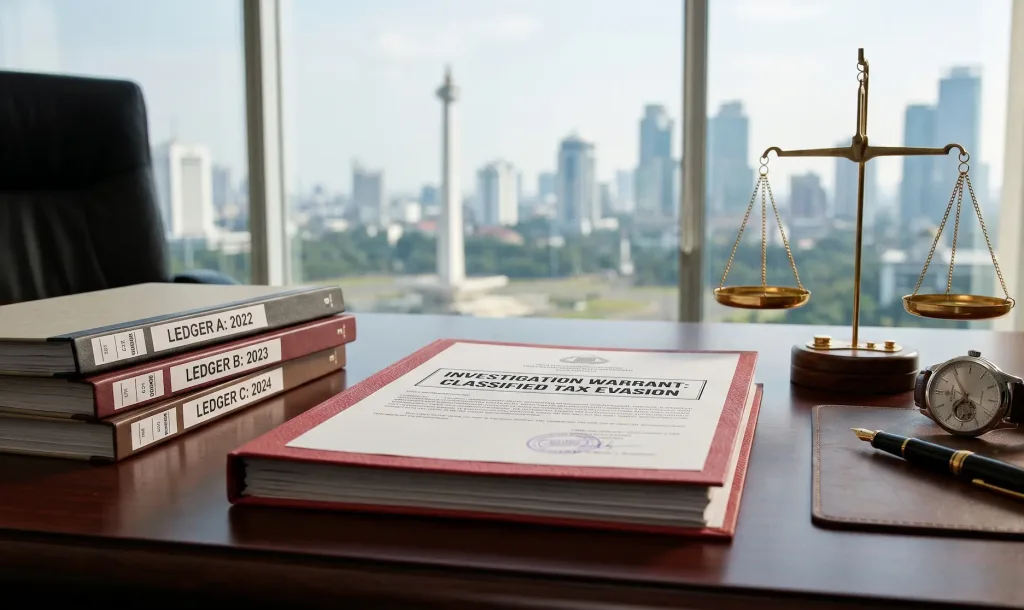
Receiving an SP2B Pajak marks the beginning of a highly intense psychological and operational pressure phase. The procedural law of the Preliminary Evidence Examination is specifically designed to gather sufficient evidence (a minimum of two valid pieces of evidence) to elevate the corporation’s status from the Inquiry phase to the Investigation phase.
There are two types of Bukper operations: Open Bukper and Closed Bukper. However, if your company has officially received the notification document, you are facing an Open Preliminary Evidence Examination (Bukper Terbuka).
Here is the escalation your corporation will experience following the landing of this document:
- Summoning of Directors and Key Employees: Bukper officers will conduct a marathon of summons involving your board of directors, General Manager of Finance, accounting staff, and even your business partners (vendors/clients) for questioning. This examination is no longer a casual discussion; statements will be recorded in an Official Report of Examination (BAP) or Official Statement Report, carrying perjury consequences if lies are detected.
- Forcible Requests for Forensic Documents: Unlike objection reviewers who offer leeway, Bukper officers possess investigator authority. They will issue official requests to borrow documents, records, and electronic data. If the company fails to hand them over within the specified time, officers can take aggressive actions, such as sealing office rooms, seizing computer servers, and physically searching company safes to secure evidence.
- Overseas Travel Ban (Cekal): If the Bukper process reveals strong indications that the directors or controlling shareholders (Beneficial Owners) might flee to evade legal responsibility, the tax institution can recommend an overseas travel ban to the Directorate General of Immigration. Your executives’ passports will be frozen, destroying your corporation’s B2B global operational mobility.
Constitutional Rights and the Lifesaving Golden Ticket: Article 8 Paragraph (3) of the KUP Law
Amidst immense psychological pressure, panic is the board of directors’ greatest enemy. Many companies attempt to destroy evidence, bribe officers, or instruct staff to lie. All these obstruction of justice actions will lead to absolute ruin in the criminal court.
The most essential fact for the C-Level suite to realize is this: Tax law in Indonesia adheres to the principle of Ultimum Remedium.
This means that criminalization (imprisonment) is the absolute last resort. The primary objective of tax law is not to jail taxpayers, but to recover state revenue losses. Based on this philosophy, even after an SP2B Pajak has been issued, the law still provides a highly crucial emergency exit (golden ticket) for corporations seeking to save their directors from behind bars.
This administrative exit is explicitly regulated in Article 8 paragraph (3) of the KUP Law (General Provisions and Tax Procedures Law, later refined in the HPP Law).
This lifesaving clause states that even if Preliminary Evidence Examination actions have been initiated, the Taxpayer, on their own volition, can disclose the untruthfulness of their actions—namely, admitting that the reported SPT was indeed incorrect or the tax invoice filling was flawed.
If your company chooses to activate this clause of disclosing untruthful actions, the criminal investigation process can be halted, provided the corporation fulfills a very heavy financial requirement:
- Paying the Principal Tax Underpayment: The corporation must deposit the actual underpaid tax owed based on the correct calculations.
- Paying a 100% Administrative Fine Penalty: As compensation for dropping the criminal threat, the company must pay an administrative penalty equivalent to 100% (one hundred percent) of the underpaid tax amount.
Executive Strategic Calculation: Suppose that due to negligence in using problematic vendor invoices, there is an underpaid VAT of IDR 50 Billion which becomes the object of the SP2B Pajak. If the company insists on fighting to the bitter end (and is proven guilty in criminal court), your director could face up to 6 years in prison, and the company could be fined up to 400%. However, if SkaiLaw SCBD intervenes, validates the officers’ findings, and recommends utilizing Article 8 paragraph (3), the company “only” needs to prepare a ransom of IDR 50 Billion (principal) + IDR 50 Billion (100% fine) = IDR 100 Billion. The moment the IDR 100 Billion is deposited into the state treasury, the case is legally closed, the investigation is halted, corporate reputation is restored, and the directors are free from the threat of imprisonment.
This is a risk management decision that demands commercial intelligence and board-level courage to save the overall survival of the corporation’s equity.
Why Multinational Corporations Absolutely Need SkaiLaw SCBD’s Mitigation Architecture
Responding to the arrival of an SP2B Pajak, facing interrogations by investigating officers, and navigating the Article 8 paragraph (3) rescue scheme is not an administrative job that can simply be handed over to internal tax staff or a standard accounting firm. This is the realm of corporate criminal law that demands forensic-level precision, high-level crisis management, and state administrative legal diplomacy skills.
At the very artery of Indonesia’s economy, Treasury Tower, District 8, SCBD, South Jakarta, SkaiLaw is designed and operates purely as an elite judicial crisis manager for commercial corporate entities.
- Radical B2B Portfolio Isolation: We firmly, absolutely, and uncompromisingly refuse to handle civilian individual tax litigation, individual general criminal defense, or family tax compliance. We enforce this extreme separation of the firm’s DNA to guarantee that all our intelligence capacity, tax criminal procedural law research, and crisis maneuvering bandwidth are 100% focused on the complexities of corporate entity asset protection (Business-to-Business), B2B governance, and the safeguarding of multinational directors.
- Hybrid Criminal-Tax Forensics (Crisis Management): Inside the Preliminary Evidence room, civil rhetoric no longer has a place. SkaiLaw’s team of litigators unites criminal legal defense acumen with forensic accounting capabilities. We re-audit the intelligence officers’ working papers, validate the legality of the alleged defective invoice evidence, and construct a defense matrix to prove that there was no malicious intent (mens rea) within the corporation, but rather pure commercial negligence that deserves to be resolved administratively.
- Measured Administrative Settlement Negotiation: The decision to surrender using the untruthful disclosure instrument or to continue fighting the investigation is highly critical. SkaiLaw SCBD acts as the protector of your cash ratio. We will brutally calculate the probabilities of proof. If the Article 8 paragraph (3) maneuver (paying the 100% fine) is the most logical business option to save corporate operations from total destruction, we will execute the application elegantly, ensuring all procedures are adhered to, and escort the issuance of the Notice of Termination of Preliminary Evidence Examination from the authorities so the corporation receives absolute legal certainty.
Conclusion: Mitigation Execution is the Key to Business Survival
The landing of an SP2B Pajak document on the directors’ desk is the highest level of crisis warning. It signals that your business operations are no longer viewed through a civil lens, but through the state’s lens of suspected financial crime. This threat carries exponential destructive power: from asset freezes, forced seizure of operational servers, and the ruin of B2B reputation in the global supply chain, to the loss of physical liberty for company executives via imprisonment.
However, the supremacy of administrative tax law was not created solely to obliterate the business world. The Ultimum Remedium philosophy provides an administrative rescue route for corporations that act proactively, cooperatively, and are accompanied by precise legal architecture. Responding to a Bukper summons with a flawed defensive posture, delaying the appointment of legal counsel, or destroying evidence is tantamount to surrendering your corporation to sink into the abyss of a criminal court with no way back.
In this existential crisis, managerial decisions within the first 48 hours heavily dictate the final outcome of the dispute. The caliber of the litigator you appoint is no longer just about negotiating numbers; it is about protecting the fundamental human rights to liberty of the board of directors and the survival of the corporate equity.
Has your company’s treasury operation and board of directors just been shocked by a sudden inspection from officers carrying an SP2B Pajak mandate, and is financial panic beginning to paralyze your corporation’s operational rationality?
Is your top management currently being subjected to marathon summons to provide Official Statement Reports, and is the corporation standing at the crossroads of crisis calculation to formulate the untruthful disclosure option to stop the corporate criminal threat?
Never speculate, take legally misleading maneuvers, or hand the navigation of this criminal crisis to an internal team that lacks survival instincts against investigating officers. Panic will obliterate strategy, and a misstep will activate a lethal Investigation status.
Build your asset and director protection architecture absolutely, right now. Contact and secure an emergency-level forensic crisis surgery consultation schedule with SkaiLaw’s team of elite corporate criminal tax litigation experts at our exclusive office in Treasury Tower, SCBD today.
Let us seal the doors of our legal war room, lay out the entire chronology of alleged crimes directed at your company, microscopically audit forensically every procedural flaw made by the officers, and construct a highly precise, solid, and lethal tax dispute resolution tactic to extinguish the criminal probe, restore business credibility, and enforce long-term operational security for the future of your B2B corporation.
Contact SkaiLaw immediately. Secure the dominance of your criminal risk mitigation navigation, protect your B2B liquidity supply chain operations, and ensure the fundamental safety of your equity and the liberty of your company’s board of directors.
Disclaimer: This comprehensive strategic publication article is exclusively designed, drafted, and engineered purely as an operational macro-level business crisis mitigation tool, the dissemination of corporate criminal risk management governance (Good Corporate Governance) information, and the enrichment of elite executive-level administrative and criminal litigation procedural law literacy specifically intended for corporate entities, C-Level Executives (Board of Directors & Commissioners), and institutional investor entities (B2B). All conceptual material descriptions, elaboration of the Preliminary Evidence Examination operational legal framework, mathematical calculation simulations of sanction threats (including the application of the 100% fine under Article 8 paragraph (3)), and tactical navigation mitigation guidelines within this reading material ARE NOT and legally cannot absolutely be extrapolated, interpreted, or relied upon formally as a valid Legal Opinion instrument, nor are they a commercial investment rescue guide, and they do not constitute specific tax advice binding the sovereignty of professional jurisdictional authority. Given that the landscape of state administrative procedural law dynamics, tax criminal law enforcement statutes, DJP law enforcement authority operational guidelines, and the constant shift of jurisprudential precedents in the Republic of Indonesia are always highly dynamic, volatile, and extremely vulnerable to instant revisions without the necessity of prior formal public notification, any form of digital interaction (including the act of reading, downloading, saving, printing, or transmitting the link to this publication page) absolutely does not trigger and de jure does not create the construction of a formal legal engagement in the form of a professional confidentiality relationship between legal practitioners and readers/clients (attorney-client privilege). SkaiLaw, strictly domiciled in SCBD and dedicating its law firm operations absolutely and exclusively solely to the realm of massive-scale commercial corporate business law crisis litigation mitigation and corporate dispute resolution, very firmly sounds a comprehensive liability waiver clause and rejects all forms of civil or criminal liability demands for potential arising claims of material economic loss, swelling of penalty fine debt obligations, forced seizure of operational server evidence, designation of suspect status upon the board of directors, or administrative negotiation failures experienced by any individual party or civil corporate entity, as a direct or indirect consequence resulting from acts of negligence in using, trusting, referencing, or executing part or all of the text from this publication as a unilateral legal decision-making reference. To absolutely neutralize the risk of criminal procedural law, design the procedural halting of the apparatus’s investigation legally, and prevent the occurrence of irreversible operational business liquidity paralysis and executive liberty threats due to erroneous regulatory interpretation, the board of directors is highly obligated by managerial fiduciary duty to immediately schedule an emergency crisis consultation agenda via a fully confidential direct physical meeting with the judicial litigation specialist advocate team from SkaiLaw, in order to obtain a forensic due diligence review of state intelligence documents and the formulation of a defense mitigation strategy blueprint that is specifically customized with judicial tactical precision according to the factual anatomy of the dispute crisis entangling the survival of your corporation.