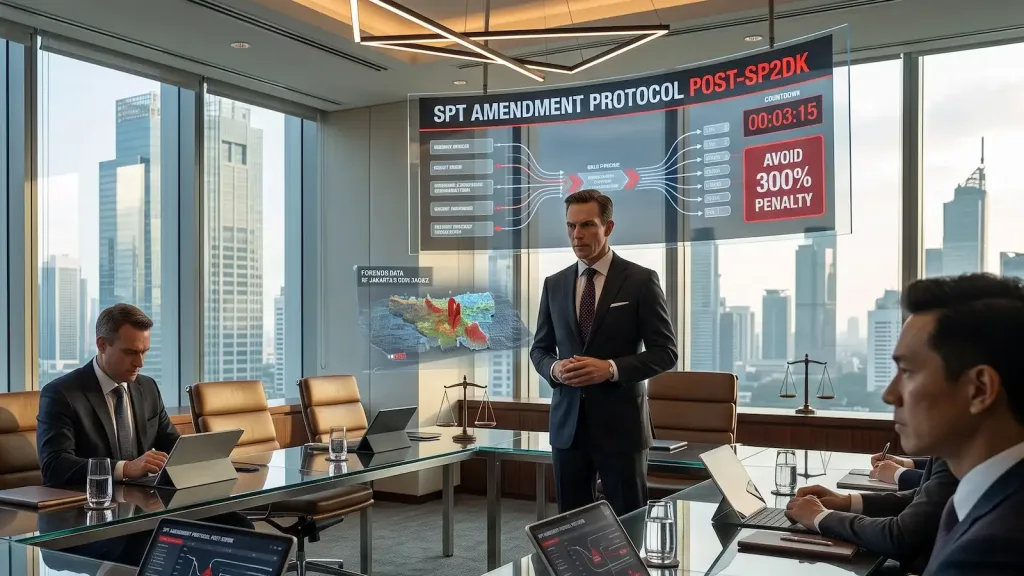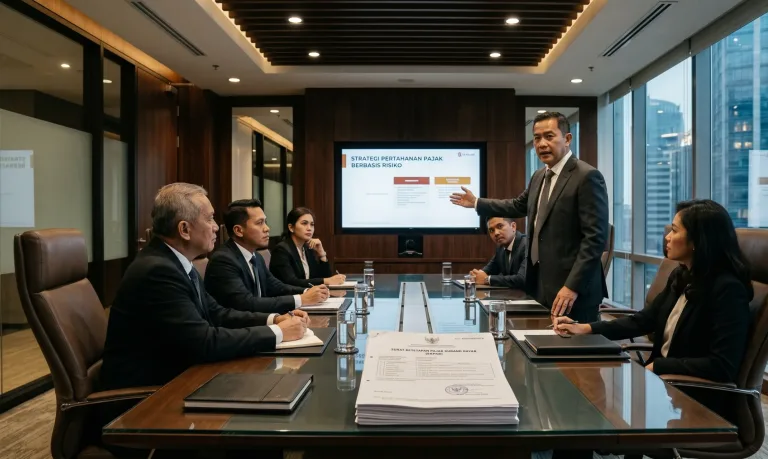
In the life cycle of a large-scale corporation operating in Indonesia, whether it is a Foreign Direct Investment (PMA) company, a publicly listed entity (Tbk), or a massive conglomerate group, receiving a visit from the tax audit team of the Directorate General of Taxes (DJP) is an unavoidable business reality. A tax audit at the corporate level is never merely a routine administrative check that can be resolved in a matter of days. It is the definitive gateway to one of the most substantial financial and legal risks capable of severely disrupting your company’s cash flow stability: The Tax Dispute
The most thrilling and mentally taxing moment for a Chief Financial Officer (CFO), Tax Director, or the executive board is when the tax auditor formally hands over the final audit result document, known as the Notice of Tax Underpayment Assessment (Surat Ketetapan Pajak Kurang Bayar, or SKPKB). More often than not, the figure printed at the very bottom of that document—which contains the accumulated principal tax amount that the tax authority claims is underpaid, coupled with highly progressive administrative penalties—far exceeds the company’s budgetary projections. The number can easily reach tens or even hundreds of billions of rupiah. A nominal value of this magnitude is never just a number on paper; it is a figure capable of entirely wiping out the company’s net profit for a full quarter, indefinitely delaying dividend distributions to eager shareholders, and forcing the corporation to drastically revise its entire Capital Expenditure (Capex) master plan.
The immediate and natural reaction from the Board of Directors upon seeing this SKPKB is usually one of fierce internal rejection. Management feels utterly confident that the internal corporate tax team has calculated, deducted, collected, reported, and remitted all tax obligations in absolute good faith and strictly following the prevailing tax laws and regulations. However, the tax auditors representing the state frequently adopt a vastly different legal interpretation, outright reject the validity of the supporting accounting documents presented, or apply testing methodologies that management feels do entirely not reflect the true commercial reality of the corporation’s business model.
When this substantial difference in legal and commercial interpretation reaches a total deadlock and cannot be resolved through mutual compromise during the Closing Conference (Pembahasan Akhir Hasil Pemeriksaan), a formal tax dispute is officially born.
Driven by corporate panic, a lack of deep understanding regarding their legal rights, or simply the desire to swiftly close the accounting books for the fiscal year, many companies immediately consider fully paying the SKPKB to avoid prolonged, exhausting legal battles. They swallow the massive financial loss even though they are acutely aware that they are on the right side of the law. This is a critical strategic error. The Indonesian General Provisions and Tax Procedures Law (Undang-Undang Ketentuan Umum dan Tata Cara Perpajakan, or UU KUP) has intentionally provided a legitimate, elegant, and highly structured legal corridor for taxpayers to mount a juridical defense against these fiscal corrections. The very first corridor of this administrative legal resistance is known as the Tax Objection Procedure (Prosedur Keberatan Pajak).
Filing a formal tax objection is not an act of corporate rebellion or an indication of non-compliance against the Republic of Indonesia. On the contrary, it is your corporation’s absolute constitutional and legal right to test the fairness of the taxation system and ensure absolute legal certainty for your shareholders.
However, executives must realize that the tax objection procedure is an administrative battlefield littered with highly sensitive procedural landmines. Making a single strategic misstep—such as being late by a single day from the statutory deadline, choosing the wrong letter format, or failing to meet the initial mandatory payment requirements—will result in your objection letter never being considered on its substantive merits. Your multi-billion rupiah defense will be immediately thrown into the wastebasket with a formal rejection stamp.
As a premier law firm with an exclusive specialization in high-stakes commercial litigation and corporate tax disputes headquartered in the prestigious Treasury Tower, SCBD, Skailaw has successfully guided hundreds of giant business entities in navigating and winning incredibly complex tax battles. This deeply comprehensive executive guide will meticulously dissect the entire anatomy of tax dispute resolution in Indonesia. We will dismantle the dangerous myths surrounding tax collection letters, detail the non-negotiable formal requirements of the SKPKB objection procedure, analyze the brutal penalty risk management that every CFO must master, and outline the exact battle tactics required to face transfer pricing disputes, which currently stand as the most terrifying specter for multinational corporations operating in Southeast Asia’s largest economy.
A Fundamental Misunderstanding: Can an STP Be Objected To?
Before we delve deeper into the formulation of high-level litigation strategies, we must firmly correct a fundamental legal misunderstanding that occurs exceptionally often in the field, even among senior financial managers and highly experienced internal legal staff.
During your ongoing correspondence with the local Tax Office (KPP), your company will frequently receive various types of billing and assessment letters. These collection documents generally fall into two main categories: Notice of Tax Assessment (Surat Ketetapan Pajak, or SKP) or Notice of Tax Collection (Surat Tagihan Pajak, or STP). Very often, a corporation receives an STP containing massive penalty charges for late filing of Periodic Tax Returns (SPT Masa), interest penalties for late payments, or other administrative sanctions whose values can swell to hundreds of millions of rupiah. Feeling that the billing is entirely unfair because the delay was caused by a server error on the DJP’s end, management hastily instructs the internal tax team to “immediately file an objection letter” to the tax office.
Herein lies the critical legal question that determines the fate of your document: Can an STP be subjected to a formal tax objection?
The answer, according to Indonesian tax law, is ABSOLUTELY NOT.
The procedural tax law in Indonesia, specifically regulated under Article 25 paragraph (1) of the UU KUP, is exceptionally specific, limitative, and rigid regarding what constitutes a valid object for an objection. Taxpayers are ONLY permitted by the law to file a formal tax objection procedure against five very specific types of assessment documents:
- Notice of Tax Underpayment Assessment (Surat Ketetapan Pajak Kurang Bayar / SKPKB).
- Notice of Additional Tax Underpayment Assessment (Surat Ketetapan Pajak Kurang Bayar Tambahan / SKPKBT).
- Notice of Nil Tax Assessment (Surat Ketetapan Pajak Nihil / SKPN).
- Notice of Tax Overpayment Assessment (Surat Ketetapan Pajak Lebih Bayar / SKPLB).
- Tax withholding or collection conducted by a third party based on the provisions of tax laws and regulations (withholding tax disputes).
The Notice of Tax Collection (STP) is strictly and explicitly not included in this list of objection objects. If you stubbornly waste your corporate energy and time sending a formal “Objection Letter” regarding an STP to the Tax Office, your letter will undoubtedly be rejected immediately due to formal defects (declared N.O / Niet Ontvankelijk verklaard). The tax authorities will not even bother to read your meticulously crafted paragraphs explaining why you feel the penalty is unjust.
So, if the objection route is firmly closed, how does a corporation seek justice and legally fight an STP that is considered incorrect or legally flawed? To fight an STP, the tax dispute resolution path resides in an entirely different legal corridor. You must utilize the legal instrument regulated under Article 36 paragraph (1) letter c of the UU KUP, which is to submit a formal request for the Cancellation or Reduction of an Incorrect Notice of Tax Collection (Pembatalan atau Pengurangan STP yang tidak benar).
The strategic capability to precisely distinguish between when to use the Article 25 route (Objection) and when to pivot and use the Article 36 route (Reduction/Cancellation) is the foundational tactical intelligence that separates elite tax litigators from ordinary compliance tax consultants. At Skailaw, the very first legal audit we consistently perform on the pile of client billing documents on our boardroom table is to strictly verify which procedural law path must be taken. This ensures the corporation does not lose its right to defense simply because of choosing the wrong administrative entrance door.
The Anatomy and Formal Requirements of the SKPKB Tax Objection Procedure
In actual corporate practice, the vast majority of material tax disputes that consume the Board of Directors’ attention and severely harm the company stem from efforts to resist the SKPKB (Notice of Tax Underpayment Assessment). The SKPKB is the definitive legal product issued after the tax auditor unilaterally makes a series of fiscal corrections that negatively impact the corporation. For instance, the auditor might deem your company’s massive promotional and marketing expenses as non-deductible expenses because the nominative list is considered incomplete according to their strict standards. Alternatively, the auditor might reject the validity of Input VAT Invoices worth billions of rupiah that you credited, simply because your business counterpart is suddenly suspected of being a fictitious tax invoice issuer.
To fight this bureaucratic arrogance embedded in the SKPKB and permanently cancel those fiscal corrections, you must step into the ring of the formal tax objection procedure. In this specific stage, the Directorate General of Taxes (DJP) acts as the “judge” over a legal product issued by its very own institution. Therefore, the UU KUP establishes incredibly strict formal requirements designed to rigorously filter out Taxpayers. Failing to meet JUST ONE of the cumulative requirements below will cause your objection letter to be entirely ignored:
1. Submitted in Writing in the Indonesian Language A tax objection can never be conveyed through a casual verbal discussion, a heated WhatsApp message, or an angry complaint phone call to your Account Representative (AR). This legal procedure must be initiated through an official written letter, utilizing the company’s valid official letterhead, typed flawlessly in proper Indonesian according to legal drafting standards. Crucially, it must be signed by an authorized party. This authorized party is strictly limited to the Board of Directors whose names are explicitly listed in the latest legally binding Deed of Establishment/Company Articles of Association. Alternatively, it can be signed by a legal Tax Attorney who possesses an official license from the Tax Court, accompanied by a valid Special Power of Attorney (Surat Kuasa Khusus).
2. State the Amount of Tax Due According to the Taxpayer’s Calculation In the realm of taxation, you cannot simply write a grievance letter stating, “We utterly reject and object to this SKPKB because the auditor’s calculations are fundamentally wrong and unjust.” An objection letter must be highly mathematical and legally definitive. You are absolutely required to present a clear, undeniable comparative table: How much is the tax due according to the tax authority’s calculation, how much is the actual tax due according to your corporation’s true calculation, and you must specifically state the exact nominal difference (the discrepancy) that you are formally disputing.
3. Accompanied by Factual and Juridical Reasons This is the absolute core of the legal drafting of a tax objection document. You do not merely state your disagreement; you must systematically, juridically, and factually dismantle the tax auditor’s arguments piece by piece. If the auditor strikes out your massive royalty expenses because they deem them to provide no real economic benefit to the Indonesian entity, you cannot merely counter with a corporate opinion. You must attach a comprehensive benefit test study, the official cross-border license agreement, international proof of transfer, explicitly cite the relevant Minister of Finance Regulations, and build a rock-solid legal argument proving that the commercial substance of the transaction (material truth) takes ultimate precedence over the auditor’s mere administrative assumptions.
4. The Principle of One Objection Letter for One Tax Assessment Notice The law heavily prioritizes strict administrative order. You cannot save paper or time by combining objections against Corporate Income Tax (PPh Badan) and Value Added Tax (PPN) assessments into one single letter, even if the respective SKPKBs were issued on the exact same day resulting from the exact same audit process. The UU KUP strictly obligates you to draft one highly specific objection letter exclusively for one specific SKPKB document number.
5. The Initial Payment Requirement (The Pay-to-Play Rule) This is the specific requirement that most frequently becomes a massive stumbling block for corporate cash flow and triggers fierce debates at the executive management level. Based on the strict rules within the UU KUP, before the objection letter is officially registered and submitted to the tax office, the Taxpayer is ABSOLUTELY OBLIGATED to first pay off the tax liability that is still due, at the very least an amount equal to what the Taxpayer has already explicitly agreed to during the Closing Conference (Pembahasan Akhir Hasil Pemeriksaan) forum. To illustrate this concretely: Suppose during the official Closing Conference minutes, you agreed to the correction of a certain minor expense item resulting in an underpaid tax of Rp 2 Billion. However, you fiercely rejected the remaining massive corrections worth Rp 18 Billion (making the total SKPKB Rp 20 Billion). Therefore, before you can legally file an objection against that disputed Rp 18 Billion, you MUST transfer and fully pay the Rp 2 Billion you agreed upon into the state treasury. The valid proof of state revenue payment (SSP/BPN) must be physically attached to your objection dossier. If your finance team is negligent and forgets to pay this agreed portion before the letter is officially registered at the tax office, your fundamental right to object to the remaining Rp 18 Billion will automatically be forfeited and lost by law forever.
The Tax Objection Deadline: Racing Against Administrative Death
In the unforgiving world of corporate tax litigation, time is not merely a flexible guideline; time is the absolute, unyielding master. Neither the panel of judges at the esteemed Tax Court nor the objection reviewers internal to the DJP possess even the slightest margin of tolerance regarding deadline compromises.
The tax objection deadline has been rigidly and firmly established by the UU KUP at a maximum of 3 (three) months, calculated strictly starting from the exact date the Notice of Tax Underpayment Assessment (SKPKB) is sent by the tax office.
As a high-level executive, you must be extremely wary of the phrase “from the date sent”. This is the most lethal administrative trap designed to catch unwary taxpayers. The three-month absolute deadline is NOT calculated from the date you receive the physical letter at your corporate reception desk or the day the CEO finally opens it. The deadline counts backward starting directly from the postal stamp date of dispatch or the official proof of delivery date recorded meticulously in the DJP’s internal system. Countless multinational companies have irrevocably lost their right to object to tax bills worth billions of rupiah simply because they erroneously calculated the deadline based on the date of physical receipt.
Three months (approximately 90 days) might initially seem like a very long time to a layperson. However, in the harsh reality of preparing a large-scale corporate defense, this time frame is incredibly narrow and suffocating. To draft a comprehensive Objection Letter that actually possesses a high probability of winning, the Skailaw commercial litigation team must conduct a brutal re-audit, gather thousands of invoice proofs that might be scattered across various regional warehouse branches, dissect checking account mutations line by line, search for highly relevant jurisprudence from the Supreme Court or past Tax Court rulings, and construct razor-sharp legal argumentation. The slower the internal management hands over this crisis to the legal team, the exponentially higher the risk that the built arguments become shallow, rushed, and ultimately ineffective.
Can this absolute three-month deadline be negotiated or extended under any circumstances? The law only provides room for an extension under one extremely rare and specific condition: Circumstances beyond the Taxpayer’s control (Force Majeure). However, you must fully realize that proving a force majeure condition in the eyes of the DJP is nearly impossible and is almost universally rejected. A national-scale natural disaster (such as a massive earthquake destroying the city) or a massive fire incident that completely incinerates all physical and digital documents in your office building might be accepted as a valid legal reason. However, standard managerial excuses such as “The President Director was on an extended business trip abroad,” “Our senior tax manager just resigned abruptly,” or “Our global ERP system was down for a month” will absolutely be rejected outright by the tax office without a second thought.
Therefore, extreme time discipline is your corporation’s very first line of defense. The exact moment the SKPKB envelope arrives at your premises, calculate your 90-day meter with extreme caution and immediately mobilize your external legal defense team.
The CFO’s Risk Calculation: The Threat of Rejected Tax Objection Penalties
Given that the objection procedure is a fundamental legal right, why do so many Boards of Directors hesitate to fight back and ultimately choose to surrender and pay an SKPKB that they know is factually wrong and arbitrary? The reason usually boils down to one terrifying psychological threat and a massive financial burden that can cripple the balance sheet: Administrative Penalty Sanctions.
The taxation system in Indonesia is intentionally and strategically designed with built-in disincentives to prevent Taxpayers from frivolously filing objections merely to stall payment time or seek a cheap negotiation loophole. The law creates severe additional financial consequences for companies that dare to offer resistance but ultimately lose the argumentation battle against the tax authorities.
This is precisely where the role of the Chief Financial Officer (CFO) becomes absolutely paramount. You must intimately understand the radical changes in risk mitigation brought about by the Harmonization of Tax Regulations Law (Undang-Undang Harmonisasi Peraturan Perpajakan, or UU HPP).
In the era prior to the enactment of the UU HPP, if your company filed an objection procedure and the decision was ultimately rejected by the DJP, your company would be hit with a punishing penalty of 50% of the disputed tax amount. This draconian 50% threat was highly effective in making many medium and large companies retreat orderly without putting up any fight.
However, since the passage of the UU HPP (which significantly revised several crucial provisions in the UU KUP), the government has slightly softened this objection penalty threat to encourage a sense of justice. Currently, the penalty for a rejected tax objection has been officially reduced to 30% (thirty percent) of the tax amount determined based on the objection decision, minus the tax that has already been paid in full before filing the objection.
Let us simulate this dispute risk concretely on the boardroom table so it is easily understood by all directors: Suppose your corporation receives an SKPKB Underpayment with a total massive bill of Rp 50 Billion. During the Closing Conference forum, you stubbornly insist on rejecting all of those corrections (you agree to Rp 0). Subsequently, you file a formal tax objection letter against the entire Rp 50 Billion bill. According to the protection of the law, the collection process for this Rp 50 Billion bill is automatically “suspended” while your objection process runs its course (meaning, your corporate bank accounts will not be blocked or forcibly seized by the tax bailiff today).
The review process rolls on. One full year later, the Director General of Taxes issues an Objection Decision Letter establishing that your legal arguments are weak and your objection is REJECTED ENTIRELY.
What is the immediate financial consequence that directly hits your cash balance? Your company now must not only pay off the principal tax debt of Rp 50 Billion, but you are ADDITIONALLY BURDENED with a rejected objection penalty of 30% x Rp 50 Billion = Rp 15 Billion. The total cash liability that must be immediately prepared and paid by your company within 1 month drastically jumps to a staggering Rp 65 Billion.
This substantial additional 30% sanction threat, which holds immense material value, is the primary reason why corporate executives must never rely on trial and error. You must utilize the services of professional tax litigators. You cannot treat the objection process as a speculative gamble on your company’s fate. If your legal arguments and supporting document evidence are assessed to be highly porous from the very beginning, the Skailaw team will never advise you to proceed to the objection stage. Doing so would be equivalent to intentionally pushing the company into an abyss of additional penalties that destroy liquidity. We always conduct a brutal, brutally honest, and commercially objective Risk Assessment before recommending your corporation to take up arms and fight the state.
Dissecting the Battlefield Map: The Latest Tax Dispute Cases
The landscape of corporate tax disputes is never static. It continually evolves and becomes increasingly complex in tandem with the DJP’s rising aggressiveness in digging up every potential state revenue to meet national state budget (APBN) targets. Based on the vast empirical experience and daily observations of the Skailaw litigation team headquartered in SCBD, the latest tax dispute cases no longer revolve around trivial, low-level administrative issues, such as finding fictitious tax invoices from obscure companies or mere calculation errors in employee income tax (PPh 21). Today’s tax auditors are equipped with highly sophisticated analytical capabilities, and they target the very heart of the corporation’s commercial transaction substance.
Several key trends of material tax disputes that currently dominate the courtrooms most frequently include:
- Beneficial Owner & Tax Treaty (P3B) Disputes: The DJP is becoming highly aggressive in canceling the application of reduced tax rates claimed by PMA companies based on Double Taxation Avoidance Agreements (Tax Treaties). They frequently suspect that the parent companies of our multinational clients domiciled in Singapore, Hong Kong, or the Netherlands are merely shell companies (conduit companies or paper companies) deliberately set up for tax avoidance. The fiscal authorities refuse to recognize these foreign entities as the true beneficial owners of the dividend or royalty flows, thereby forcing the imposition of a normal 20% withholding tax rate which heavily burdens the global group.
- Intercompany Cost Reasonableness Disputes (Management Fees & Royalties): Massive expense burdens paid by subsidiary companies in Indonesia to affiliated head offices abroad (head office allocations) are crossed out wholesale by auditors. The reason for the strikeout is that auditors demand an extreme standard of proof regarding the existence of the service, far exceeding standard business norms, and deem that the costs provide no real economic benefit to the operational entity in Indonesia.
- Turnover Equalization Disputes: This is a classic yet still highly lethal trap. There is often a difference between the total turnover reported in the Corporate Income Tax Return (SPT PPh Badan) and the accumulated delivery value in the VAT Return (SPT PPN). This difference is frequently caused purely by timing differences in revenue recognition, customer down payments, or the implementation of new financial accounting standards (PSAK). However, tax auditors often take a brutal shortcut by immediately correcting and assuming the discrepancy as “deliberately hidden turnover” by management.
However, among all the arrays of dispute issues above, there is one absolute behemoth that constantly haunts the CFOs of multinational corporations and drains the highest litigation costs today: The Transfer Pricing Dispute.
The Horror of Proof: Complex Transfer Pricing Disputes
For large-scale domestic conglomerate groups and Foreign Direct Investment (PMA) companies, the transfer pricing dispute is the highest caste of all tax disputes. This specific dispute invariably involves astronomically large nominal values and demands the most complex level of economic proof in court.
This transfer pricing dispute surfaces when your company conducts material transactions (such as the sale and purchase of raw materials, export of finished goods, provision of intercompany loans, up to the payment of brand royalties) with affiliated companies (companies located within the same ownership group). The DJP is granted exceptionally strong legal authority through Article 18 of the Income Tax Law (UU PPh) to intervene. They can forcibly redetermine the amount of your company’s income and deductions if they subjectively assess that the value of the affiliated transactions you reported is deemed unfair.
The main problem is, tax auditors will by default never trust the prices you determine yourself within your internal group contracts. They will aggressively test whether your transactions comply with the Arm’s Length Principle (ALP) / Prinsip Kewajaran dan Kelaziman Usaha.
The way the tax audit team challenges your numbers is highly sophisticated and academic. They no longer guess; they utilize access to extremely expensive global commercial databases (such as Orbis, Osiris, or Bloomberg) to search for comparable independent companies out there. Their attack scenario goes like this: If the Operating Profit Margin (OPM) of your manufacturing company in Indonesia is reported at only 2% this year, but the auditor finds a set of independent comparable companies in the same industry with an average profit of 8%, the auditor will immediately construct a narrative that you are manipulating prices. They will assume you are intentionally shifting profits to your affiliated company in a tax haven country. Armed with this assumption, the auditor will forcibly correct your company’s profit margin to 8%, recalculate the corporate income tax, and issue an SKPKB with tax liabilities reaching hundreds of billions of rupiah.
Fighting a transfer pricing dispute at the objection stage cannot be done merely armed with complaint letters and normative arguments. You need an impenetrable fortress in the form of highly robust economic protective documents: Transfer Pricing Documentation (consisting of the Master File, Local File, and CbCR). This is where the absolute superiority of the Skailaw Transfer Pricing expert team shines. We dismantle the aggressive arguments of the tax auditor not just with legal rhetoric, but by completely deconstructing the economic methodology they utilized. We trace their raw data and frequently succeed in proving before the panel that the comparable companies chosen unilaterally by the auditor represent a comparison between “apples and oranges”. The comparable companies are proven to be entirely incomparable in terms of functional analysis, assets utilized, and risks borne in the market. By demolishing the pillars of their comparables, the auditor’s multi-billion correction becomes conceptually flawed and possesses no valid legal basis to be maintained.
The Highest Judicial Escalation: Battling in the Tax Court
Let us assume the worst-case scenario in the tax objection procedure workflow. What if all your brilliant legal and economic arguments are rejected outright by the DJP’s internal objection review team, and your company is now officially slapped with the 30% penalty sanction? Does the company have to raise the white flag at this point, surrender entirely, and give up tens of billions in cash assets to pay the state’s bill?
Absolutely not. The tax dispute resolution process has not reached its final endpoint. Indonesian law grants you the absolute right to take this issue out of the clutches of the Ministry of Finance institution, heading straight into the true, independent judicial arena: The Tax Court (Pengadilan Pajak).
This most decisive legal escalation step is called an Appeal (Banding). The tax dispute court (Pengadilan Pajak) is the only specialized judicial body in Indonesia authorized to examine tax disputes. Although its physical location is administratively situated within the Ministry of Finance area, technically, judicially, and in terms of judicial fostering, this institution operates directly under the absolute power of the Supreme Court of the Republic of Indonesia. It is within these courtrooms that you can expect the most objective justice.
Tax Court Judges do not work under the crushing burden of meeting trillions of rupiah in tax revenue targets like the officials at the KPP. They take an oath to decide cases purely based on valid documentary evidence submitted by both parties, the search for material truth of the transactions, and the judge’s own inner conviction. In this appeal stage inside the courtroom, the corporate litigation attorney team from Skailaw truly takes full control over your defense narrative.
However, the courage to file an appeal post-defeat at the objection stage also comes with an extreme risk profile that must be calculated meticulously by the Board of Directors. The UU HPP once again sets up a much larger penalty landmine. If your company is proven to lose at the Tax Court Appeal level, the administrative penalty sanction which was originally 30% will drastically jump by law to 60% (sixty percent) of the amount of tax still underpaid based on the Appeal Decision. This is high-stakes litigation poker that severely spikes the adrenaline of corporate decision-makers.
Success in the Tax Court is no longer determined by your good intentions. Your absolute victory will depend entirely on tactical brilliance in drafting the Appeal Memorandum (Surat Banding), the completeness and absolute validity of the documentary evidence presented, the ability to find fatal loopholes in the DJP’s written response, the capacity to present highly credible Industry Expert Witnesses to convince the panel of judges, and razor-sharp legal argumentation (pleadings) in a courtroom that adopts the principle of free evaluation of evidence (vrij bewijs).
Why Skailaw is the Architect of Your Tax Defense in SCBD
Corporate tax disputes in the modern era are not trivial matters of filling out annual tax return forms or merely performing mathematical calculations in Excel. Tax disputes are massive-scale administrative and judicial litigation wars. You cannot delegate the defense of your company, worth hundreds of billions of rupiah, solely to internal accounting staff with zero trial experience, or to routine compliance tax consultants unaccustomed to the brutal pressure of arguing before a panel of supreme judges. You need more than just a report generator; you need a Tax Litigator with nerves of steel, unparalleled strategic vision, and vast high-stakes experience.
At the Skailaw firm, proudly occupying a highly strategic position in the business epicenter of Treasury Tower, SCBD, we do not merely read rows of numbers in your financial statements. We are deeply accustomed to reading the underlying intentions, commercial business goals, and legal interpretations behind every tax regulation that is so often misused to unjustly correct your corporation.
- Exclusive Corporate Focus (B2B): We consciously dedicate all our energy, profound scientific infrastructure, and elite network exclusively to protecting the financial structures of large-scale limited liability companies and multinational entities. We strictly refuse to handle individual tax compliance matters to ensure our focus remains razor-sharp purely in the commercial business realm.
- Objective Penalty Risk Mitigation: At Skailaw, we act as your ultimate risk manager. We will not push you with sweet promises to proceed to the tax objection process if, from our initial brutal audit, we conclude that your foundational evidence is porous. Our absolute integrity is to protect your cash flow from financial suicide in the form of the devastating 30% or 60% penalty threats.
- Hybrid Expertise (Law and Economics): Winning incredibly complex transfer pricing disputes and massive-scale Corporate Income Tax disputes requires a rare, seamless fusion between deep forensic accounting understanding and razor-sharp judicial procedural law comprehension. Our elite team at Skailaw harmoniously combines the competencies of both these worlds to utterly obliterate every unilateral correction argument from the tax auditor in the face of the independent Panel of Judges.
Conclusion: Never Surrender to Unilateral Corrections
Receiving a piece of SKPKB paper bearing a fantastic billing amount from the tax office is not the final death sentence for your corporate balance sheet. The democratic taxation legal system in Indonesia has strategically designed the tax objection procedure as a vital check and balance power instrument so that corporate taxpayers do not become helpless victims of the arbitrary actions of audit officials.
However, you must constantly remain aware that this instrument of protection demands extreme procedural compliance. From the absolute necessity of calculating the unyielding three-month deadline without any tolerance, fulfilling the minimum agreed tax payment requirements, to the absolute necessity of presenting undeniable legal argumentation and material evidence. A minor strategic error at this critical stage will formally close the door to justice and wide open the gates to a punishing 30% penalty sanction that has the potential to obliterate the liquidity of corporate finances.
The resolution of tax disputes must always be viewed by management through the lens of a legal investment project for supreme asset protection. If your corporation is factually and commercially operating on the right path of material compliance, there is absolutely no reason to fear or retreat from facing tax auditors at the institutional objection desk, or even fighting openly in the courtrooms of the tax dispute court.
Has your company’s operations recently been shocked by the arrival of an SKPKB carrying highly aggressive and unreasonable correction values?
Are you currently facing a highly complex cross-border transfer pricing dispute and feeling utterly confused calculating the massive risk of a 30% penalty threat if you make the wrong move?
Remember, your 90-day time meter is ticking relentlessly without pause. Do not waste precious time arguing aimlessly internally. Immediately contact the elite commercial tax litigation team from Skailaw at Treasury Tower, SCBD today. Let us lay out all your tax audit result documents on our highly confidential boardroom table, let us brutally dissect and audit the strength of the tax authority’s arguments, and let us build an impenetrable fortress of objection strategy that will silence those baseless corrections forever.
Contact us now. Secure your corporation’s net profit from arbitrary tax assessments.
Disclaimer: This article is compiled exclusively for service information purposes. Every single tax case possesses highly unique characteristics. Past dispute resolution results do not in any way guarantee similar outcomes in the future. Contact Skailaw for specific and highly confidential case consultations.