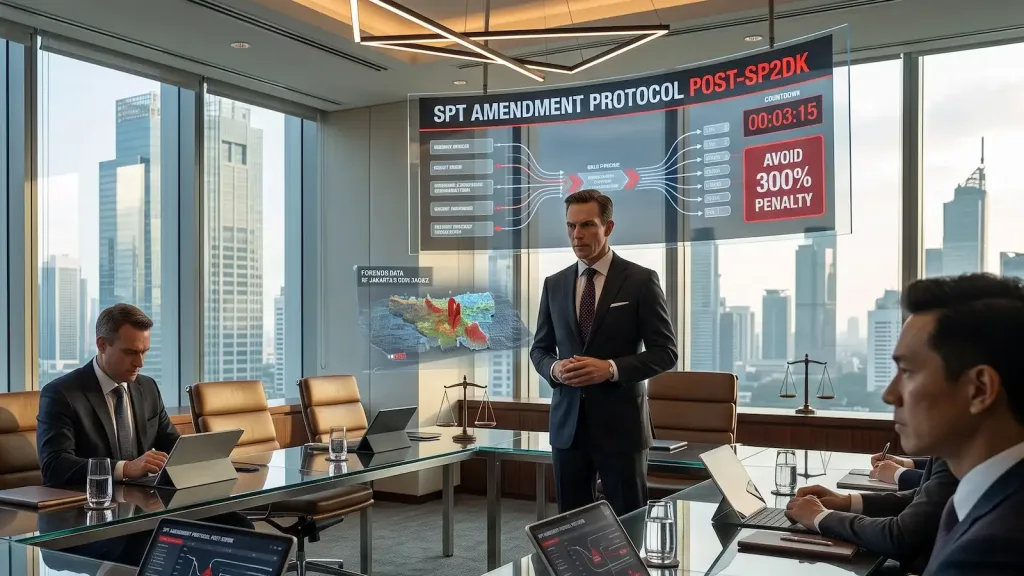
The massive deployment of over 350.000 Surat Permintaan Penjelasan atas Data dan/atau Keterangan (SP2DK)—official tax warning letters—by the Directorate General of Taxes (DJP) throughout 2026 has ignited systemic panic in multinational corporate boardrooms. The state’s Compliance Risk Management (CRM) engine is now driven by sophisticated algorithms that no longer tolerate a single Rupiah of discrepancy between e-Faktur data, withholding taxes, global data exchange (AEoI) integration, and corporate financial statements. When this brown envelope lands on the desk of a Chief Financial Officer (CFO), the primal instinct of most internal accounting departments is to immediately log into the DJP Online portal, search for “how to amend the tax return (SPT) after receiving an SP2DK“, and click the approval button simply to end the pressure from their Account Representative (AR).
This is a fatal structural error that routinely results in corporate liquidity suicide.
Executing a tax return (SPT) amendment without the foundation of forensic-standard Equalization Working Papers and solid administrative law correspondence is equivalent to signing a confession in an interrogation room. When you blindly amend figures just to appease an algorithm or satisfy an AR’s reprimand, you might successfully close one specific finding, but simultaneously, you open Pandora’s box for field auditors to dismantle every other expense account. Worse, if the calculation methodology is flawed, an administrative penalty that should have been minor can explode into a Preliminary Evidence Investigation (Bukti Permulaan/Bukper) threat, risking astronomical fines of up to 300%.
Facing the arrogance of this tax intelligence algorithm, standard in-house accounting approaches are no longer sufficient to protect corporate capital. Operating absolutely from the epicenter of commercial power at Treasury Tower, District 8, SCBD, South Jakarta, Skailaw is engineered purely to orchestrate high-level tax law mitigation and counter-offensives. We strictly reject and isolate our firm’s portfolio from all retail, individual, or SME tax disputes, ensuring that 100% of our fiscal intelligence bandwidth, forensic accounting acuity, and constitutional legal aggression is weaponized exclusively to save the equity of macro-level B2B corporations and Foreign Direct Investments (PMA) from audit annihilation.
This extensive forensic Executive Brief is designed as an emergency navigation map for the C-Suite. We will deconstruct a real-world case study of a failed SPT amendment in 2026, dissect the strict constitutional deadlines, analyze the anatomy of cross-equalization, and formulate an absolute amendment architecture that will force the AR to close your case without daring to issue a Tax Audit Warrant (Surat Perintah Pemeriksaan/SP2).
Anatomy of a 2026 B2B Blunder: The Tragedy of Admitting Guilt
To comprehend the lethal nature of executing amendments without forensic litigation oversight, we must dissect a real-world case that devastated a multinational heavy-equipment manufacturing PMA in the first quarter of 2026.
This B2B corporation received an SP2DK questioning an anomalous discrepancy of Rp 45 Billion between the Output VAT reported in their monthly VAT returns and the Revenue recorded in their Annual Corporate Income Tax Return (SPT PPh Badan). Gripped by panic as the 14-working-day deadline approached, the internal accounting department decided to take a shortcut. They filed an amended Corporate Income Tax Return, unilaterally acknowledging the fictitious additional revenue to perfectly match the VAT figures, and immediately remitted billions of Rupiah in underpaid taxes and interest penalties to the state treasury. The CFO assumed the case was successfully closed.
The Legal Reality That Followed: That hasty maneuver triggered a full-scale red flag within the DJP’s central system. By suddenly inflating revenue by Rp 45 Billion without providing a rational Cost of Goods Sold (COGS) matrix or expense ratio, the company’s Gross Profit Margin became a mathematical anomaly that defied industry logic.
The tax authority viewed this amendment not as administrative compliance, but as a strong indication that the company had been intentionally hiding profits. The DJP’s algorithm concluded that if the company could so easily “find” Rp 45 Billion in missing revenue, there must be hundreds of billions more hidden in other accounts. The following month, the local Tax Office Head issued an All-Taxes Audit Warrant (SP2). Field auditors intervened, confiscated the General Ledger, identified weaknesses in their Transfer Pricing structure, and ultimately issued an Underpayment Tax Assessment Letter (SKPKB) totaling nearly Rp 80 Billion.
The initial intention to avoid a minor SP2DK penalty mutated into an audit catastrophe that drained shareholder liquidity. This occurred purely due to management’s ignorance regarding equalization protocols prior to amending returns.
The Constitutional Window: When is an Amendment Legally Permissible?
Tax law in the Republic of Indonesia grants a “Prerogative Right” to taxpayers to voluntarily amend their Tax Returns (SPT), but executives must understand that this constitutional right carries a strictly rigid legal expiry date.
Under Article 8 of the General Provisions and Tax Procedures Law (UU KUP), you are free and entitled to amend your SPT ON THE ABSOLUTE CONDITION that the Director General of Taxes has not yet initiated an audit action. Herein lies the race against time.
Phase 1: Receiving the SP2DK (Days 1 to 14) This is your Golden Window. The company’s status is still under “Supervision” (Pengawasan), not “Audit” (Pemeriksaan). During this phase, the right to amend the SPT remains Valid and Wide Open. The corporation can voluntarily remit any tax shortfall with a significantly lower monthly interest penalty (calculated based on the benchmark interest rate plus a reasonable uplift factor).
Phase 2: Issuance of the Tax Audit Warrant (SP2) If the SP2DK deadline is ignored or the AR deems your response irrational, they will propose an audit. Once the SP2 is issued and delivered to your corporate front desk, the DJP database automatically locks your SPT. Your prerogative right is Absolutely Forfeited. You can no longer log into the system to make amendments. From this point forward, every finding by the authority will be penalized with exponential administrative assessment fines.
Phase 3: Issuance of Preliminary Evidence Investigation (Bukper) If the CRM system detects suspicions of criminal tax offenses (e.g., the use of fictitious tax invoices), the company’s status escalates to a Bukper investigation. Regular amendment rights are dead. The only remaining option is the Disclosure of Untruthful Acts (Article 8 paragraph 3 of the KUP Law), which carries a punitive fine of 100% of the underpaid tax amount.
Forensic Equalization: The Heart of B2B Amendment Tactics
The biggest mistake executives make when searching for “how to amend the tax return (SPT) after receiving an SP2DK“ is looking for technical software guides on how to click through the e-Filing menu, rather than seeking the methodology to formulate the numbers to be inputted.
Before you even open the tax portal, your accounting team must compile Equalization Working Papers. Equalization is the reconciliation process proving that discrepancies between one tax type and another, or against commercial Financial Statements, are standard accounting variances, not evasion.
Here are the three most critical equalization matrices that Skailaw’s forensic team rigorously prepares before executing an amendment for our macro-level clients:
A. VAT vs. Corporate Income Tax Revenue Equalization (Most Common Case)
Tax officers frequently issue SP2DKs because the Revenue in the Annual Corporate Tax Return does not match the total VAT Tax Base (DPP) reported monthly. If the numbers differ, the AR accuses you of hiding sales. Our team will not immediately amend the SPT to force the numbers to match. We will prove the existence of Timing Differences. For example:
- Down Payments: VAT is issued when the down payment is received, but under accounting standards (PSAK), the revenue (Corporate Income Tax Revenue) cannot be recognized yet because the goods have not been delivered.
- Foreign Exchange (Forex) Gain/Loss: Tax invoices are issued using the Ministry of Finance’s exchange rate at the time of the transaction, while bookkeeping uses the central bank’s (BI) middle rate at year-end.
If we present this spreadsheet accompanied by an accurate General Ledger, that multi-billion Rupiah discrepancy is legally justified. You do not need to amend your revenue, and no underpaid tax is required. The case is closed.
B. Salary Expenses vs. Article 21 Withholding Tax (WHT)
ARs often highlight that “Salary and Wage Expenses” on the Income Statement are massive (e.g., Rp 100 Billion), but the total gross income reported on the Employee WHT (Article 21) return is only Rp 80 Billion. The AR will suspect you failed to withhold taxes on the remaining Rp 20 Billion. Before amending the Article 21 return and paying absurd penalties, the Skailaw team dissects your ledger. We frequently prove that the Rp 20 Billion difference actually consists of: Company-paid social security (Jamsostek), Benefits-in-Kind (Natura, such as office catering or uniforms which may not be taxable objects depending on prevailing rules), or severance pay reported separately. Once again, this matrix prevents a cash-draining amendment.
C. Professional/Rental Fees vs. Article 23/26 WHT
If your Financial Statements contain “Professional Fees,” “Consulting Fees,” or “Heavy Equipment Rental,” the AR automatically looks for Article 23 WHT remittance proofs. If the value is smaller, an SP2DK is issued. Our team filters the ledger to prove that a portion of those “Rental Fees” pertains to software leased to a company in Singapore protected by a Tax Treaty (P3B), thereby subjecting it to a 0% or lower rate, rather than 2%.
Executive Architecture: The 4-Step Protocol to Reply to SP2DK

If, after internal Due Diligence and equalization, the AR’s findings are deemed valid—for instance, there was a genuine human error where staff forgot to issue a tax invoice for a massive B2B transaction—then amending the SPT is the inevitable way out. However, its execution must be strictly guarded by a litigation protocol.
In the Treasury Tower SCBD war room, we deploy this four-step architecture to lock down corporate data sovereignty:
Step 1: Data Quarantine & Interruption Communication (Days 1-7)
Never touch the DJP Online system before sending an official letter. We release an Initial Response Letter to the Tax Office, stating that the Board of Directors has instructed an internal cross-examination audit and requesting an extension for analysis. This administrative maneuver legally halts the algorithm’s timer that threatens to throw your company’s status into the “Auto-Audit” basket.
Step 2: Ripple Effect Simulation
If we decide the client must amend Output VAT due to a missed transaction, our forensic auditors simulate the ripple effect. If Output VAT increases, Corporate Tax Revenue must increase. If revenue increases, profit surges. Do we need to locate uncredited Input VAT invoices or unrecognized deductible expenses to neutralize that profit spike? We ensure this amendment does not create a newer, more dangerous risk profile.
Step 3: The Silent and Precise Amendment
Only after the matrix is 100% secure is the SPT amendment submitted. The company pays the shortfall plus administrative penalties (Article 8 paragraph 2 interest). We ensure the billing codes (KAP/KJS) generated are perfectly accurate. Selecting the wrong billing code renders your multi-billion Rupiah payment unreadable by the system, and the AR will still consider you in default.
Step 4: The LHP2DK Kill Switch
This is the ultimate tactic almost universally forgotten by in-house accounting departments. After the SPT is amended and paid, the case is not legally over. Skailaw SCBD litigators dispatch a “Final Response Letter” summarizing the entire Equalization Working Paper, attached with valid State Revenue Receipts (BPN).
In this letter, engineered with stringent administrative legal language, we dictate to the authority that the corporation has been fully cooperative in resolving the material finding, and imperatively demand the AR to immediately issue the Data Clarification Report (LHP2DK) with a “Case Closed” status. This letter acts as a legal seal that kills the authority’s maneuvering room to prolong the case or extort new findings from the same issue.
The Restitution Trap: When Amendments Summon Auditors
An absolute emergency warning for every CFO: mastering “how to amend the tax return (SPT) after receiving an SP2DK” also means mastering when you must restrain yourself from amending it.
There is one fatal scenario that serves as the trigger for your company’s destruction: Amendments Declaring an Overpayment (Restitution) or a Larger Loss.
The DJP algorithm system has rigid rules. If, in response to an SP2DK, your accounting department amends the SPT and the result creates a scenario where your company claims money back from the state treasury (Overpayment), or inflates the Loss Compensation for the following year, the Head of the Tax Office is mandated to issue an Audit Warrant (SP2). The state will never refund trillions of Rupiah to a taxpayer without conducting a brutal, total physical audit of your entire general ledger.
If your B2B corporation has not undergone a comprehensive Tax Diagnostic Review and is unready to face field auditor interrogations, never trigger this Overpayment button. Often, absorbing a slight commercial loss discrepancy is infinitely cheaper than opening your corporate vault doors to state examiners, which could result in positive corrections across hundreds of other expense accounts.
Macro-Level Defense Architects: The Supremacy of Skailaw SCBD
Delegating the resolution of high-level pre-audit crises to operational accounting staff—who are trained only to compile journals, not to fight in the litigation arena—is a breach of fiduciary duty that will decimate your B2B capital balance sheet. Amending state documents without a constitutional protection framework is akin to walking through a minefield blindfolded.
Exclusively headquartered and centralizing its operational command at Treasury Tower, District 8, SCBD, South Jakarta, Skailaw is engineered purely to lift the burden of numerical diplomacy and administrative state law from the shoulders of B2B directors.
- Extreme B2B DNA Purification: We radically reject all retail tax dispute clients, home-scale enterprises, and individuals. This absolute concentration ensures that 100% of our CRM tax intelligence bandwidth, mastery of cross-border B2B transaction equalization methodologies, and administrative negotiation brutality is weaponized purely to lock down the equity sovereignty of macro-corporations and restore the independence of the Board of Directors from bureaucratic intimidation.
- The “Kill It Before It Grows” Protocol: Skailaw’s operations rest on the philosophy of mass destruction prevention. We do not allow your company’s case to escalate to the Audit phase. The response letters and amendment equalization matrices we construct are designed to be so logical, precise, and legally solid that they literally lock down the Account Representative’s logic, forcing them to issue a Case Closed status that same day, thereby eradicating the potential issuance of an SP2.
- Corporate Criminal Immunity Shield: Every figure and narrative we approve for alteration during the amendment process has passed a legal burden-of-proof stress test. We ensure that the good faith demonstrated by your SPT amendment can never be framed or twisted by investigators in the future as evidence admitting to criminal tax engineering.
Strategic and tactical decisions regarding how to amend the tax return (SPT) after receiving an SP2DK act as the demarcation line clearly separating corporations that successfully retain their liquidity sovereignty for expansion from those that end up destroyed by state asset confiscation. The 2026 algorithm deploying 350.000 mass summons letters is specifically designed to harvest panic.
Never gamble the safety of your supply chain operational assets, the confidentiality of your dual bookkeeping, and the legal liberty of your Board of Directors by responding to this data intelligence threat amateurishly. Lay the foundation of your multinational corporate defense supremacy at the most absolute epicenter of legal immunity.
Contact us in the strictest confidence immediately to secure an executive-level pre-audit equalization crisis consultation with the elite commercial tax litigators of Skailaw at our exclusive offices in Treasury Tower, SCBD today. We will dissect the e-Faktur data anomalies accused by the authorities, engineer a forensic equalization matrix masterpiece immune to new red flag traps, and force the state bureaucratic instruments to submit to the rationality of your bookkeeping. Close your corporation’s warning case forever, prevent the apocalypse of operational bank account freezes, and absolutely protect the sovereignty of your B2B multinational expansion without the slightest compromise.
Disclaimer: This entire comprehensive strategic publication manuscript is designed and released exclusively as an instrument of fundamental Good Corporate Governance literacy and a navigation guide for high-risk pre-audit compliance architectures for C-Level executives of macro-level corporations (B2B/PMA). All conceptual information, juridical elaborations, 2026 SP2DK raid case studies, and deconstructions of the DJP CRM algorithm system detailed within this document—including but not limited to interpretations of constitutional deadlines under Article 8 of the KUP Law, Equalization Working Paper design methodologies for VAT and Corporate Income Tax, and the implications of Audit Warrant (SP2) issuance resulting from Overpayment (Restitution) amendment maneuvers—are presented concisely strictly for macro-managerial enlightenment purposes. This document CANNOT and absolutely must not be interpreted or relied upon as a formal Legal Opinion possessing binding legal force before tax authorities, Account Representatives, field auditors, tax investigators, or the Panel of Judges at the Tax Court and District Court.
Given the extreme volatility of Big Data and global information exchange (AEoI) tax surveillance algorithm updates, the fluctuating discretionary shifts in audit instruction issuances depending on the subjectivity of local Tax Office Heads, and the severe vulnerability in the application of administrative state law regarding unilateral penalty assessments by bureaucratic authorities, the Skailaw law firm (operationally centralized absolutely and domiciled in SCBD Jakarta) radically exempts itself and strictly denies any form of liability (responsibility for damage claims), whether inside or outside the courtroom, within the realms of civil, administrative, or criminal law. This waiver of legal liability specifically covers all potential macro-level material and immaterial entity-extinction losses—such as the issuance of Underpayment Tax Assessment Letters (SKPKB) with exponential penalty fines due to independent calculation errors during amendments, unilateral forced revocation of e-Faktur capabilities, the freezing of corporate operational foreign exchange bank accounts by State Bailiffs, or the placement of directors under Preliminary Evidence Investigation (Bukper) status—that arise as a fatal logical consequence of trial-and-error e-Filing amendment button maneuvers, the disregard of rigid legal correspondence tactics, or independent procedural actions taken by the reading directors, without first being grounded in formal, comprehensive, thorough, and certified forensic due diligence procedures strictly escorted by the elite commercial dispute litigators from our firm.
In order to shield your multinational corporation from the apocalypse of pre-audit legal uncertainty that will inevitably cause permanent operational cash flow paralysis, the board of directors and board of commissioners are strictly mandated by their financial fiduciary duty to immediately secure and schedule a highly confidential mitigation formulation agenda (attorney-client privilege) at our representative office to microscopically and precisely dissect the SP2DK letter structure and data anomalies, and subsequently formulate an architectural tactic for B2B amendment matrices completely aligned with future investigation threat mitigation and securing the integrity of your corporation’s commercial expansion projection profile.